
Meet the Class of 2026: Nomi Maqbool, “I May Have Lost My Sight, But I Have Found My Voice”
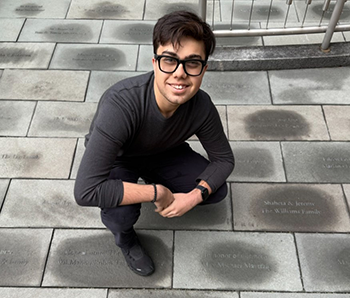
Vista Murrieta High School senior, Nomi Maqbool, sees his disability not as a roadblock, but a speed bump
When he was born in 2007, Nomi Maqbool’s parents didn't know anything was out of the ordinary with their little boy.
His parents soon noticed that Nomi was unable to do basic finger tracking, respond to light, or notice large objects.
Doctor’s visits led to more doctor’s visits. Tests and specialists led to additional testing and specialists. Finally, before his first birthday, Nomi was diagnosed with Leber’s congenital amaurosis (LCA), an extremely rare disease that affects the retinas in babies’ eyes. Babies born with LCA like Nomi, start with very low vision that worsens as they age, often leading to blindness.
“Then, my parents learned that the rods and cones in my eyes would be unable to absorb colors—and then the same thing with depth perception, with light, and all these different issues that are outside of LCA that became this blind package,” Nomi said. “What I like to say is when God was making me, he gave me the bundle deal.”
Back in 2008, there was no direct cure for LCA, but that didn’t stop Nomi’s parents from looking for treatments and options to find a way to seek out a detour on the road to potential total blindness for their newborn son.
Nomi’s father learned about gene therapy in 2011 and secured a spot for Nomi in phase three of a national clinical trial. “Basically, they put a lab-made gene into the one-fourth most inner part of my retina. The goal was not to try and regain vision, but simply to try and stop the degeneration,” Nomi explained.
Multiple trips back and forth to Philadelphia for appointments, surgeries, and treatment were a major challenge for Nomi and his family, as it was time for him to start preschool.
A Supportive and Challenging Education Begins
Nomi’s educational career began in special education classrooms, but his frequent medical absences led to a shift in his education to one-on-one instruction with part-time placement in a typical classroom.
After repeating the second grade, Nomi described his academic career as “thriving” and “as a rocket ship going up.”
With periodic medical appointments for the clinical trial reduced to annual trips to Philadelphia, Nomi was able to focus on school and his mobility with support from the Riverside County Office of Education—both at school and at home.
“They were trying to get me to learn self-advocacy because my parents were very big on independence,” Nomi said. “Learning how to use a cane was profoundly impactful for me, because, for blind people, your cane is your eyes. I can't see while I'm walking, but the cane can feel where I'm going, and it can tell me things. Mobility is really about your personal safety.”
RCOE Special Education Principal Dena Slocum, who served as Nomi’s Orientation and Mobility Specialist at the time, recalled early mobility lessons spent walking through Nomi’s neighborhood.
“Nomi often pointed out homes with impressive exterior lighting or other features he envisioned for his own future home—an observation uncommon among elementary-aged students,” Dena said. “Nomi has always been an exceptional student to work with, in part because he demonstrates a strong personality and a clear sense of his preferences and goals. He is intelligent, determined, and poised to become a role model for other students with visual impairments.”
Nomi’s first memories of working with RCOE staff also included learning Braille after second grade, and additional support that encouraged self-advocacy over the years.
Physical devices that have assisted Nomi in the past include a slant-board, computers, magnifiers, 20/20 pens, extra lights, and more. Now, Nomi’s laptop and iPad have multiple digital tools he has mastered that will be with him in his future endeavors—regardless of his visual capabilities.
“It's not that I have to meet with my team regularly. It's simply that I can send a text message or an email, and they’re always willing to help,” Nomi said. “With my iPad, I’m basically able to handle my own case by myself and able to function independently in and outside of the classroom, and that feels beneficial for me.”
Nomi believes that the RCOE support team, in coalition with his personal goals and aspirations, is the scaffolding holding him up. After a counselor convinced Nomi to try an AP course, he immediately thrived.
“I loved it. I thought, ‘Why did people say these were hard?’, and the next thing I know, I'm taking all AP classes,” Nomi said.
Nomi’s hard work in high school has set him up to potentially be named the valedictorian of his graduating class at Vista Murrieta High School (VMHS) in the Murrieta Valley Unified School District.
In the spring of his 11th grade year, Nomi registered for an anatomy class at a local community college. While there, it was recommended to him that he switch his major away from public health.
“I got a phone call from the head of the accommodation service center, and their message was that I should just switch my major, because it would be too hard to accommodate for disabled people in STEM fields,” Nomi shared. “They suggested the humanities because it was easy for them to get textbooks in large text.”
That interaction further motivated Nomi to pursue his dreams of a career in the medical field.
After some initial challenges, he was able to use an assistive microscope with the help of an in-class aide—even completing detailed lab assignments related to dissecting cadavers. Nomi proceeded to earn an “A” in his anatomy class—both the lecture and the lab.
“I think that kind of also helped me in my attitude, that I just want to prove this guy wrong,” Nomi said.
A Day in the Life of Nomi
Nomi’s message for those who wonder what it’s like to live without sight is instructive.
“Don't look down on me or think I am any less capable of things that someone without a disability can do,” Nomi said. “You don't need to pity me. I am an adult. I would say I'm thriving in my life. I have goals and aspirations that my disability requires me to work extra hard for, but I will not stop.”
One of the more common questions Nomi receives is what he can actually see. He confessed to struggling with how to answer that question because he has never experienced typical 20/20 vision that most of the world takes for granted.
Nomi utilizes high color contrast (such as white text on a black background) enlarged materials, text to speech services, listening to lectures, and lots of accessible PDF files.
“I love PDF files, but there are ways of constructing them that are beneficial to someone like me trying to use a screen reader,” Nomi said. “If people don’t use alt text and make their documents accessible, it’s the opposite of beneficial. It’s detrimental.”
One thing he’s sure about, is that even despite the successful gene therapy treatment, he knows his vision is still degenerating.
“I don't like to say I'm defined by my blindness, but my cane is my scarlet letter,” Nomi said. “While I have faced that challenge, and still continue to face that today, it will always be there. It's the cross I will always have to bear.”
Advances in technology have helped Nomi flourish—from digital learning tools all the way to his trusty Apple Watch that motivates him to walk at least 20,000 steps every single day.
“My number one goal every day is to close those exercise rings. I have a streak going for three years now,” Nomi shared proudly. “I wouldn't say I'm a health nut, but those rings are getting closed. Even with a cane.”
In the future, he is researching the potential for a guide dog that would help him ensure he closes his all-important exercise rings each day.
“His name may be Retina...just to be a little ironic,” Nomi said jokingly.
What’s Next for Nomi
Nomi sees his academic success as the springboard to successfully achieve his dreams and aspirations.
Nomi already serves as an advisory board member at Vanderbilt University’s EMPOWERing Youth with Visual Impairment (VI) Project. The program equips transition-aged students with visual impairment living in rural communities, their families, and the transition professionals who serve them with the virtual supports to improve postsecondary education and employment outcomes.
“What really keeps me going is to be able to say I did it, and to prove those wrong who say I can’t go to grad school, get married, start a family, become a doctor, or live what some would call a ‘normal’ life,” Nomi said.
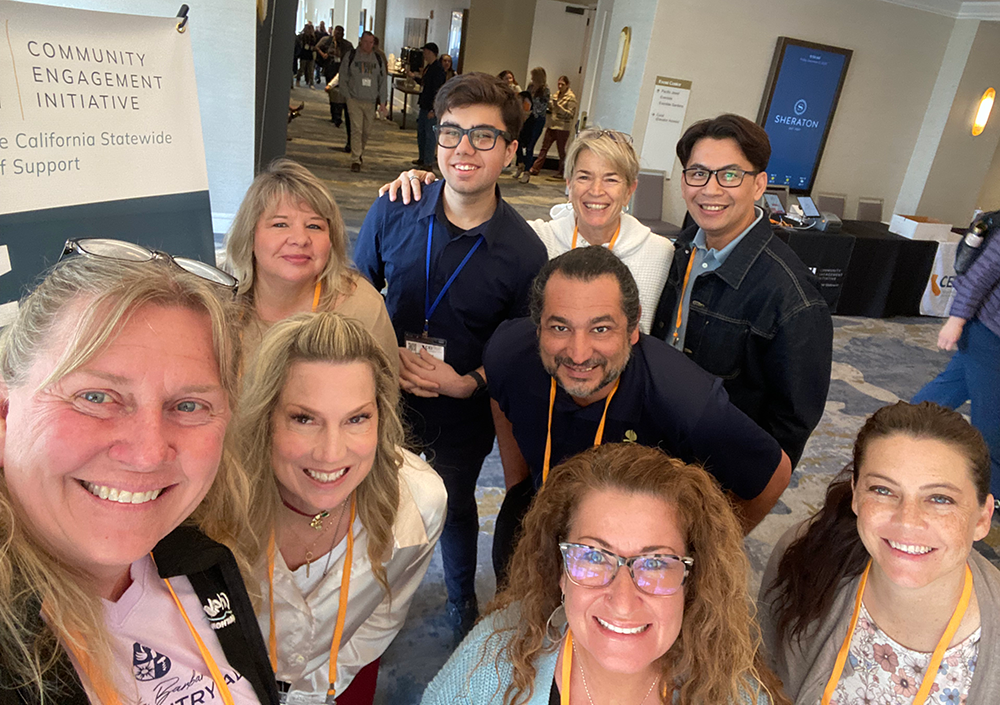
Nomi serves on the Community Engagement Team (CEI) for RCOE, which applies improvement science to help teams authentically engage families, students, and their communities. As a Riverside County student with firsthand experience in the educational system, Nomi provides a powerful and authentic voice.
He has been accepted into UC Berkeley and will enroll as biology major this fall. For graduate school, Nomi’s plan is to pursue a MD/JD program which combines a medical doctorate and a juris doctorate in just six years, with years of residency and fellowships to follow.
“There was such a small percentage of individuals who were able to receive the treatment that worked for me, and I'm just so profoundly grateful for that,” Nomi said. “I feel like becoming a physician is my way of giving back to society, and to the field of medicine.”
Whichever school invites him to participate in their institution will be welcoming an inspirational student who steps on to campus with three associate degrees at the age of 18.
“When you live with a disability the odds are kind of already stacked against you,” Nomi said. “I may have lost my sight, but I have found my voice. And, when you find your voice, you create the ability to be able to pursue your dreams.”